Monday, January 31, 2011

The Cabman's Shelter


After the chaotic dissonance of the climactic "Circe" chapter, Joyce begins the third section of the book ("The Homecoming") with "Eumaeus." As if to call attention to exhaustion on the part of the two main characters (and, perhaps, on the part of the reader by this point!), Joyce writes the chapter in a boring, tired, cliche-ridden style. Eumeaus was Odysseus's faithful swineherd friend, the first person approached by Odysseus (in disguise) upon his long-awaited homecoming to Ithaca. The chapter is full of red herrings and frustrated identifications. Here we meet a seafaring wanderer (Murphy) whose tales of adventure seem to make him a Ulyssean character … but this proves to be a falsehood, as Bloom, despite his obvious external differences, is actually more akin to Ulysses in his moderation and intelligence. The long-awaited meeting between Bloom and Stephen proves somewhat anticlimactic, taking place amid a series of deceptions, falsehoods, and miscommunications. Despite our expectations, Joyce here frustrates the reader, refusing to give us an overly dramatic or emotional scene. Finally, the chapter calls into question Truth and Fiction – Bloom reads a “factual” newspaper account of Dignam’s funeral, which, despite it pretenses to accuracy, does not come close to portraying exactly what occurred. (Paradoxically, Joyce’s novel Ulysses, like other great works of fiction, comes closer to portraying Truth than do most works/forms that claim to do so.)

Sunday, January 30, 2011

The Magic of Circe


In The Odyssey, Circe transforms Odysseus's men into swine; possessing a magic plant (moly) given to him by Hermes (Mercury), Odysseus is able to withstand Circe's magic and ultimately free his men from her spell.

Joyce’s 180-page closet drama (that is, a dramatic work meant to be read, rather than performed) embedded in his epic novel contains speaking parts for virtually every character introduced in the book, including inanimate objects such as The Fan and The Soap. Having taken realistic/naturalistic fiction as far as it can go, Joyce now experiments with symbolic/unrealistic fiction. After leaving the maternity ward, Bloom instinctively (perhaps paternally?) follows a very drunk Stephen and his cohorts to a brothel in "Nighttown," Dublin’s red-light district. Appropriately (given the transformational qualities of Circe’s magic) the drama consists of a series of phantasmagoric, even psychedelic images and hallucinations that serve to probe the psychological depths of both Bloom and Stephen, with each character confronting the main source of his neurosis: Bloom his failure as husband to Molly, Stephen his failure as son to his mother. Ultimately, the two characters experience a catharsis, purging them through the emotions of pity and terror. By end of “Circe,” Bloom has regained his manhood, asserting himself by saving Stephen from the whores, his drunken friends, two antagonistic military men, and the police. Finally, this father-son connection is solidified, as Bloom escorts Stephen back to his home at 7 Eccles Street.

Thursday, January 6, 2011

Bloody Oxen of the Bloody Sun

Arguably the most difficult section of the book, this chapter merely attempts to draw a comparison between the gestation of a fetus and the development of the English language through a narrative style of a series of pastiches reflecting the major stages of literary development. In doing so, I think Joyce is recalling Stephen's notion of Shakespeare's having "fathered" a literary race as well as the ongoing theme merging the act of biological creation with the act of artistic creation. In the Homeric episode, our hero and his men land on the island of Helios, the sun god, with Odysseus warning his men (per prophetic orders from both Circe and Tiresias) to refrain from harming Helios's sacred cattle. When inclement weather causes the men to be stranded on the island long enough to have expended their provisions, Odysseus's men go behind their captain's back and slaughter enough cattle for a six-day feast. When the weather clears up, the men depart, only to be subsequently struck down by Zeus's thunderbolt, leaving Odysseus the sole survivor.

The chapter takes place at the maternity hospital, with Mina Purefoy in the midst of labor and Bloom meeting up with Stephen, Mulligan, and a bunch of drunken med students. Here we finally see Bloom in an overtly paternalistic role, lamenting Stephen's drunkenness and the fact that Stephen is wasting his life-bearing semen on prostitutes (or "murdered his goods with whores" (391)). This becomes the central correlation for Joyce, who sees the story of the slaughtered cattle as a "crime against fecundity" - that is, copulation (or masturbation) without any intention of actually creating life. Conversation here includes contraception, birth defects, infant mortality, and even Buck Mulligan's offer to set up a "national fertilizing farm ... [with] his dutiful yeoman services for the fecundation of any female" (402). Lynch mocks Stephen's literary ambitions: "That answer and those leaves ... will adorn you more fitly when something more, and greatly more, than a capful of light odes can call your genius father" (415). The chapter ends with the group heading out to another bar, and eventually to Dublin's red-light district; Bloom will follow, presumably to keep a watchful eye on young Stephen.

My advice on reading this chapter is as follows:
Option 1: Read it slowly carefully, with a lot of outside help to piece together stylistic and thematic elements.
Option 2: Read it rather quickly, getting the gist of the action and using any one of a number of online guides/summaries to help ground you
Option 3: Don't read it. Just get an online summary so you can move on to the next (slightly) more comprehensible chapter. I won't tell the teacher.

Thursday, November 11, 2010

Fireworks on the Beach


This episode is named for Nausicaa, the Phaeacian princess who, while playing ball with her maids-in-waiting, discovers the naked Odysseus washed up on the shore of their island. Though she desires to marry our hero, she and her parents help facilitate Odysseus's safe return to Ithaca.
As with the previous episode, we again find the chapter narrated from a specific perspective, this time that of a young woman, Gertie MacDowell. Unlike the pessimistic narrator of "Cyclops," who has a tendency to deflate and reduce, Gertie's voice is that of a sentimentalist, one who tends to soften and romanticize reality. The contrast between the language and style of Gertie and that of Bloom - whose consciousness we reenter halfway through the episode (p. 367) - is stark indeed. The episode makes great use of a series of other ironic contrasts: Gertie's love vs. Bloom's lust, the Virgin Mary vs. the temptress Gertie, the spirituality of the religious ceremony vs. the materialism and fireworks of the Mirus bazaar, to name but a few.
Note also a few other interesting aspects of this chapter. The beach on which Bloom is walking is the same stretch of beach Stephen walked on that morning during "Proteus"; Bloom may find Stephen's poem on p. 381. Also, note that it is now 8:00 at night. For the first time in the book, a significant stretch of time has elapsed: we're missing two or three hours in between "Cyclops" and "Nausicaa," which apparently involved a visit of Bloom to the Dignam house. Another curious point involving time is that Bloom's watch has stopped at 4:30 ... likely the time Blazes Boylan and Molly got it on. Another point of interest involves Bloom's masturbation; not only is this yet another taboo bodily function (along with defecation, urination, menstruation, and copulation) not often presented in so-called realistic novels, but it is also proof positive that there is nothing wrong with Bloom "down there." Bloom can indeed "get it up." Finally, here we are over 300 pages into the novel and Joyce continues to provide the reader with expository information, including finally (on p. 357) a physical description of the novel's protagonist! Of course, nailing down Bloom (or, for that matter, any human being, Joyce seems to suggest) is as difficult as completing the cryptic message Bloom leaves for Gerty in the sand: "I. AM. A."

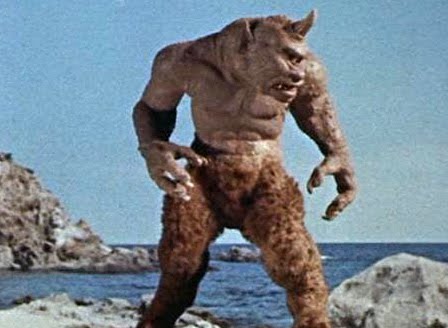
The Cyclops


Not only is the "Cyclops" episode one of the most memorable of Homer's epic, but this chapter is, for my money, one of the best and funniest in the novel. In Homer, Odysseus finds himself in the land of the brutal, lawless, one-eyed Cyclopes, imprisoned in a cave by Polyphemus, who is swallowing Odysseus's men two at a time. Telling Polyphemus that his name is "No Man," Odysseus gets the Cyclops drunk on wine, pokes out his one eye with a pointed, flaming spear, and escapes the cave by hiding under Polyphemus's sheep as they exit the cave. As he sails away in triumph, Odysseus commits a fatal error by revealing his true name, an action that allows Polyphemus to enlist the help of his father Poseidon (the sea god) to make the rest of Odysseus's journey miserable.
The Joycean counterpart to the raging Polyphemus is "The Citizen," a physically powerful yet small-minded and xenophobic Irish nationalist whose myopia causes him to see things in a distorted and narrow-minded way. Here the narrative structure is essential to an understanding of the section, for the chapter contains two narrators. The primary narrator is the nameless first-person ("I"/"eye") misanthrope who narrates the goings on on Barney Kiernan's pub from the perspective of deflation and reduction, treating Bloom and others with a great deal of scorn and ridicule. This narrator's tale, however, is interrupted some 33 times by parodies embodying "various pompous, sensational, or sentimental literary styles" (Gifford 314). Thus, the second "narrator," often referred to as the parodist, serves to inflate and exaggerate the importance of the actions of the chapter by relating them according to any number of writing styles, the most prominent being the overinflated style of the Irish Revivalists (recall the Library chapter) attempting to translate/rewrite ancient Irish epics.
Perhaps most notable in this chapter is Bloom's near-heroic response to the anti-Semitism expressed by The Citizen, who, ironically, bemoans Irish oppression. Bloom stands up to The Citizen, not by resorting to physical violence (perhaps Joyce's comment on the post-WWI view that heroism no longer can be equated with military triumphs?), but rather by hurling a series of rejoinders aimed at deflating the Citizen's prejudices -- "The Savior was a jew and his father was a jew ...Your God was a jew. Christ was a jew like me" (342) -- just as The Citizen hurls a cracker box at Bloom, mirroring the Cyclops's hurling a boulder at Odysseus's ship. However, one of Bloom's finest moments in the novel comes in his confronting the hatred of The Citizen with his doctrine of justice, tolerance, and ... Love. That's right, it takes the Jewish Leopold Bloom to best express and embody the central doctrine of Christ's teachings.

Monday, September 27, 2010

The Sirens Sweetly Singing ....


It's now about 4 p.m., and while Bloom sits in the bar at the Ormond Hotel, Blazes Boylan is well on his way to his tryst with Molly. Everyone knows the story of the Sirens, the sweet-singing temptresses whose irresistible song lures sailors to their doom by causing them to crash their ships on the nearby rocks. Odysseus, of course, has his cake and eats it too, by filling his sailors' ears with wax and tying himself to the mast; that is, Odysseus hears the Sirens' song, but withstands the temptation toward destruction the song invites. Simply put, this chapter is about music. There are 157 references to 47 different pieces of music. After spending five months exploring musical composition, Joyce - a great singer and music lover in his own right - said he could no longer enjoy music, as he now knows all the "little tricks" of musical composition. The section begins with an "overture" of sorts, each fragment reappearing later in the chapter. Look for musical references throughout: for example, at one point Simon sings a song about Lionel while Leopold listens, and the three (singer-subject-listener) fuse into a three-note chord, "Siopold!" (276). "The Croppy Boy" plays a significant role in the chapter - here are the lyrics: http://www.james-joyce-music.com/song16_lyrics.html. In one sense, this chapter involves the Ulyssean Bloom heroically resisting the call of the Sirens, which here becomes the temptation to wallow in overly sentimental (and paralyzing) nostalgia, as evidenced by the drunken men who have surrendered to alcohol, singing, and weeping: "Thrill now. Pity they feel. To wipe away a tear for martyrs. For all things dying, want to, dying to, die" (286). Ultimately, Joyce himself (as he does so often in this novel) bursts the bubble of self-importance by having Bloom conclude the chapter with his own anal trumpet!

I Wanna Rock!


"The Wandering Rocks" represents the beginning of the second half of the novel (chapter 10 out of 18), and the first of what will become a series of radical experiments in form. In Homer, this episode is not even really an episode, but rather a few lines in which Circe warns Odysseus to stay away from these rocks, which appear, disappear, and reappear in the sea. Thus, like many of the wanderings in this chapter, it is a "near miss." This chapter contains 19 sections, or short vignettes, many of which occur simultaneously; rather than being organized chronologically according to time, the chapter presents itself spatially, as a sort of birds-eye view of Dublin. In fact, one can argue that in this chapter, Dublin itself is the central protagonists (though our friends Stephen and Bloom make appearances as well). The chapter begins with religion (Father Conmee) and concludes with politics (the visiting Viceroy). In the 5th section, Blazes Boylan buys "fat pears" and "ripe shamefaced peaches" for Molly, while in the 10th section Bloom is simultaneously buying her a soft porn novel, Sweets of Sin. In sections 11 and 13, we meet the destitute Dilly Dedalus, who receives no financial assistance from her father or her brother.